帰り道Side B · No.07
Music for the late ride home
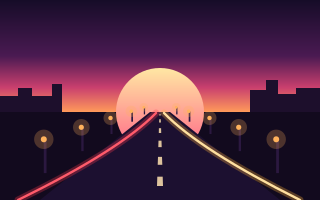
I’ve come to believe that the best part of a night out is often the ride home.
Last Saturday, after a friend’s birthday, I got into a taxi at half past one. The driver had the radio on so low that it was more of a rumour than a sound. I asked if I could open the window a little, he nodded, and for twenty-five minutes the city slid past like one very long tracking shot: closed shops with their lights still on, a bridge, a petrol station glowing like a spaceship, a man walking a very large dog with enormous seriousness.
I put my headphones in. It was perfect.
Why the way home
In Japanese, kaerimichi (帰り道) just means “the way home”, but I like how much room there is in the word.
The way there is full of decisions: where, when, who, what to wear, whether you’re late. The way home has none. The night has already happened. You’re tired in the good way, the city is doing all the work, and your only job is to sit still and watch. That’s the moment music was made for. It doesn’t have to compete with anything. It only has to keep you company.
And there’s this: the way home is the only time the city belongs to you completely and wants nothing from you. During the day it’s always selling something. At night it just is.
Rules for a late-ride playlist
I take this more seriously than I should, so I have rules:
- Nothing that makes you want to dance. You’re sitting down.
- Nothing too sad. You’re almost home.
- A steady pulse, roughly the speed of streetlights going past at sixty.
- Instrumentals are welcome. The driver won’t mind, and neither will your tired brain.
- The last song matters most.
The road songs
The first song on my list is always Yumi Arai’s “Chūō Freeway” from 1976. It’s about a night drive on a Tokyo expressway, and it does something I find incredibly moving: it takes completely ordinary roadside landmarks and turns them into something like a love letter, just because they’re seen at night, from a moving car, next to someone you like. Arai was writing about Tokyo, but it works on any highway. It works on my ring road.
Then Tatsuro Yamashita’s “Ride on Time” (1980), because it’s impossible to feel bad during that chorus, and a car at night is a great place not to feel bad.
And TM Network’s “Get Wild” (1987). It was the ending theme of the City Hunter anime, which means a whole generation connects it with the moment the episode ends and the credits roll over a night city. Putting it on in a taxi is cheating. I do it anyway.
The instrumentals
For the long stretches, when the road is empty and straight:
Toshiki Kadomatsu’s Sea Is a Lady (1987), an instrumental album led by guitar that sounds like a coastline seen from a car window at night, even if you’re nowhere near the sea.
Casiopea’s Mint Jams (1982), a live album on which the band plays so precisely that it feels as if the car is gliding on rails.
“Truth” by The Square (1987) — the band later became T-Square — which somehow sounds triumphant and calm at the same time. It’s a song for passing under a long row of orange lights.
And when the road really opens up, Yellow Magic Orchestra’s “Rydeen” (1979), which is basically a small, happy electronic horse galloping alongside the car.
If you’re not alone in the car, agree beforehand who’s in charge of the music. It matters more than you’d think, and it will save you at least one argument at a red light.
The last stretch
Here’s the game I always play and almost always lose: I try to time a song so that it ends exactly when the car stops outside my building.
You can’t plan it. Traffic lights get in the way, the driver takes a different turn, the song has a long fade-out you forgot about. But maybe once every few months it lines up — the final chord, the click of the handbrake, the engine idling — and I sit there for a second with the feeling you get at the end of a good film, when the credits start and nobody in the cinema wants to move yet.
My song for that last stretch is Miki Matsubara’s “Mayonaka no Door / Stay With Me” (1979). The title means “the midnight door”, which is exactly where you are.
A few practical notes
Sit in the back, on the side away from the traffic, and ask before you open the window. If you’re walking the last bit, keep one ear free. Say thank you to the driver: they’re working while the rest of us are drifting.
The full list is on the playlists page, under “Late Ride Home”. Put it on, look out of the window, and let somebody else drive.